Barrier-free showers, grab bars, roll-under vanities, and comfort-height fixtures — built beautifully for every stage of life.
ADA (Americans with Disabilities Act) guidelines were written for public facilities, but the principles translate powerfully into residential remodeling. For homeowners in Prescott and across Yavapai County, applying ADA standards to a private bathroom means designing around real human needs: a minimum 60-inch turning radius for wheelchair users, curbless or roll-in showers with no lip to trip over, grab bars anchored to blocking in the wall at precise heights, roll-under sinks and vanities that allow a wheelchair to pull fully underneath, and door openings of at least 32 to 36 inches clear. These are not arbitrary rules — they are dimensions drawn from decades of research into how people with mobility challenges actually use a bathroom safely and independently.
Prescott's population skews older than the national average, and Yavapai County consistently ranks among Arizona's fastest-growing retirement destinations. That means a large and growing share of local homeowners are navigating aging joints, recovering from surgery or injury, or supporting a family member with a disability. Planning an accessible bathroom remodel now — rather than retrofitting after a fall or a health event — almost always costs significantly less and delivers a better-integrated result. Blocking can be added behind tile before the walls close up. Structural changes to widen a doorway are far simpler before finish materials go in. The time to act is before you need it, not after.
At Infinity Kitchen & Bath, we design accessible bathrooms that look nothing like a hospital room. Frameless glass enclosures on curbless showers look sleek and modern. Teak shower benches read as a spa amenity, not a medical device. Comfort-height toilets are standard in luxury bathrooms. Matte porcelain tile with a slip-resistant coefficient of friction looks beautiful underfoot. Our team has built dozens of fully accessible bathrooms in Prescott, Prescott Valley, and Chino Valley — each one tailored to the homeowner's specific mobility needs, aesthetic preferences, and long-term goals. Explore our full range of bathroom remodeling services to see how accessibility fits within a complete transformation.
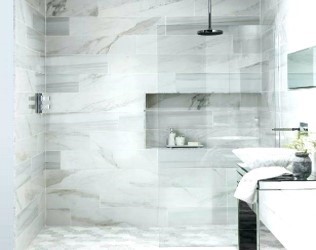
Every accessible bathroom project is different, but these are the core features we design and build for homeowners who need a safer, more functional bathroom.
A zero-threshold shower entry eliminates the biggest trip and transfer hazard in any bathroom. We build curbless showers with properly sloped linear drains so water flows away from the entrance — no lip, no step, no barrier. Roll-in designs are sized to allow full wheelchair access and turning inside the enclosure.
ANSI A117.1 specifies exact placement heights and load ratings for grab bars — horizontal bars at 33–36 inches for toilet transfers, angled bars inside showers for stability while standing or sitting. We install backing (blocking) in the wall framing first, so bars are anchored to hold 250 lbs in any direction, not just drywall.
Standard toilet bowls sit at 14–15 inches — difficult to rise from for anyone with knee, hip, or lower-back issues. Comfort-height (or ADA-height) toilets measure 17–19 inches from floor to seat rim, dramatically reducing the effort and pain of standing. We pair these with correctly positioned grab bars for a complete transfer solution.
A knee-clearance vanity — open underneath, mounted 27 inches off the floor minimum — allows a wheelchair user to roll directly to the sink and use it comfortably. We insulate exposed plumbing to protect legs from heat, install single-lever faucets within easy reach, and can design floating or furniture-style vanities that look beautiful even without lower cabinet storage.
The CDC reports that more than 235,000 people visit emergency rooms each year for bathroom fall injuries. We specify tile with a dynamic coefficient of friction (DCOF) of 0.42 or greater on wet surfaces — the threshold recommended by the Tile Council of North America for wet areas. Options include matte porcelain, textured natural stone, and luxury vinyl plank with grip surfaces.
ADA guidelines call for a minimum 32-inch clear opening (36 inches preferred) and 60 inches of maneuvering clearance in front of the door. We reframe doorways, relocate plumbing or fixtures if necessary, and can replace swing doors with barn-style sliders or offset hinges to recover precious clearance in tighter floor plans.
Yavapai County is one of the fastest-growing retirement destinations in the American Southwest. More than a third of Prescott residents are 65 or older, and that proportion continues to climb. For many families, that means an aging parent moving in, a homeowner navigating a post-surgical recovery, or a spouse managing a new mobility challenge after decades in the same home. The bathroom is statistically the most dangerous room in the house for older adults — and also the room where independence matters most.
The financial case for planning ahead is compelling. An accessible bathroom incorporated into a full remodel adds a modest percentage to the overall project cost. Retrofitting after the fact — cutting open tiled walls to install blocking, widening doorways through finished framing, replacing a standard shower pan with a linear-drain curbless system — can cost two to three times as much for the same result. Many Prescott homeowners are also eligible for financial assistance: the VA's Home Improvements and Structural Alterations (HISA) grant covers up to $6,800 for accessibility modifications for qualifying veterans. Some Medicare supplement plans and Medicaid waiver programs cover bathroom modifications as durable medical equipment. We can help you understand what documentation our work can provide.
Planning an accessible remodel also protects your home's value. Buyers in the 55+ market — the fastest-growing buyer demographic in Yavapai County — actively seek homes where they can age in place without expensive future renovations. A well-executed accessible bathroom is a genuine selling point, not a liability.
The most persistent misconception about accessible bathrooms is that they have to look clinical. They absolutely do not — and our portfolio proves it. The same curbless shower entry that accommodates a wheelchair or a walker also creates the open, spa-like aesthetic that appears in every luxury bathroom design magazine. Frameless glass panels maximize light and visual space. A fold-down teak bench in the shower corner reads as a high-end spa feature, not a medical accommodation. Comfort-height toilets are now standard in nearly every upscale bathroom remodel regardless of accessibility needs.
Linear floor drains allow large-format tile to run continuously from the bathroom floor into the shower without interruption — a design detail that reads as sophisticated and modern. Matte or textured tile, chosen for its slip resistance, often looks more refined than the glossy surfaces it replaces. Contrasting grout lines and accent strips can call attention to design intent rather than function. The grab bars themselves have evolved: today's options include brushed nickel, matte black, polished chrome, and oil-rubbed bronze in sculptural shapes that integrate naturally with a designer faucet set.
Infinity Kitchen & Bath takes the same approach to an accessible bathroom as to any luxury remodel — starting with your aesthetic goals and layering in the functional requirements so that the finished space serves both beautifully. Browse our full bathroom remodeling services to see how we approach the complete picture.
Accessible remodeling requires more upfront planning than a standard cosmetic update. Here is how we manage every project from first conversation to final safety check.
We begin with a detailed in-home consultation focused on how the bathroom is actually used — and how it needs to work going forward. We discuss the specific mobility challenges, medical equipment (wheelchairs, walkers, shower chairs), the involvement of a caregiver, and any future needs to plan for. This is not a generic checklist; it is a conversation about a specific person's daily life and safety. We measure the existing space, photograph obstacles, and leave with a clear picture of what the bathroom must accomplish.
Our design team produces a scaled CAD floor plan showing turning radii, fixture centerlines, grab bar locations, door swing clearances, and knee-space dimensions. We cross-reference ADA guidelines and ANSI A117.1 standards at every step. You review the plan before any demolition occurs, and we refine it until it solves every problem you identified in the assessment. Materials — tile, fixtures, grab bars, vanity — are selected at this stage so lead times don't delay the build.
This is the phase most homeowners never see but that determines whether the accessible features hold up for decades. We open walls to install backing (blocking) for every grab bar location — solid lumber or metal plates anchored to studs that will hold the rated 250-lb load. If the doorway needs widening, we reframe the rough opening now. If the subfloor needs reinforcement or re-sloping for a linear drain system, it happens before any finish materials are installed. Getting this phase right is what separates a safe accessible bathroom from one that looks accessible but isn't.
With structure and waterproofing complete, we install the elements that make the bathroom both functional and beautiful. The curbless shower system — including the linear drain, waterproof membrane, and large-format tile — is set to our exact slope specifications. Grab bars are anchored through tile into the pre-installed blocking. The roll-under vanity, comfort-height toilet, and any specialty fixtures like hand-held shower wands, thermostatic controls, or fold-down benches are set and connected. Non-slip flooring goes in as the final floor finish, chosen to complement the tile palette selected in design.
Before we consider a job complete, we walk through every accessibility feature with you — or with the family member who will be using the bathroom. We test grab bar load capacity, verify drain slope, confirm turning clearances with the actual mobility equipment that will be used, and walk through the operation of all fixtures. We provide documentation of the grab bar backing installation for any insurance or VA reimbursement claims. If anything does not work exactly as intended, we fix it before we leave.
ADA-compliant bathrooms are one part of a broader approach to building a home that works for every stage of life. Explore these related services from Infinity Kitchen & Bath.
Beyond the bathroom — we assess and modify kitchens, hallways, entries, and living spaces so your Prescott home supports independence at every age. Grab bars, ramp entries, lever handles, improved lighting, and more.
Learn More →Climbing over a tub wall is one of the most common causes of bathroom falls. We convert your existing tub alcove into a barrier-free, curbless walk-in shower — the single most impactful accessibility upgrade in most bathrooms.
Learn More →Our walk-in showers are designed from the ground up for barrier-free entry, generous interior dimensions, and beautiful finishes. See how we combine accessibility and luxury in every custom shower we build.
Learn More →Accessible features are not a separate product line — they are design decisions we integrate into every complete bathroom remodel we build. Whether your project is accessibility-driven or style-driven, the result is the same: a bathroom built to last, built to code, and built for your life.
See All Bathroom Remodeling ServicesADA (Americans with Disabilities Act) refers to specific dimensional standards — turning radii, reach ranges, knee clearances — developed primarily for public and commercial facilities. ANSI A117.1 is the corresponding standard applied in residential contexts. "Aging in place" is a broader philosophy: designing a home so a person can remain there safely and comfortably as they age, often without meeting every precise ADA dimension. In practice, many of the features overlap significantly. Our aging-in-place modifications incorporate ADA-derived dimensions wherever they improve safety and usability — the labels are less important than building what actually works for the person who will use the space.
No — ADA requirements are legally mandated only in public accommodations and commercial facilities. Private residences are not required to meet ADA standards. However, the standards themselves are based on sound ergonomic and safety research, and applying them to a private bathroom results in a genuinely safer and more functional space. Some government assistance programs and VA grants require modifications to meet specific ADA or ANSI standards to qualify for reimbursement, so documentation of compliance can have financial value even in a residential setting.
Cost depends heavily on scope. A focused accessibility upgrade — adding a roll-in shower conversion, installing compliant grab bars with proper backing, and replacing the toilet — might range from $8,000 to $18,000 depending on materials and structural needs. A comprehensive accessible bathroom remodel that includes widening doorways, installing a roll-under vanity, replacing all flooring, and fully restyling the space can range from $20,000 to $45,000 or more. The best way to get an accurate number for your specific project is a free in-home consultation — we measure, assess, and provide a detailed estimate with no obligation.
Technically yes, but it is not ideal. Grab bars installed through finished tile into drywall alone cannot safely hold the required 250-lb load — the drywall will fail before the bar does. A proper installation requires the bar to be anchored into wall studs or into solid blocking (lumber or metal plate) installed between studs behind the wall surface. If blocking was not installed during the original construction or remodel, the wall must be opened to add it. This is one of the strongest arguments for planning accessible features before any tile work begins — it is straightforward to add blocking before the walls close up, and expensive to do so afterward.
No — and for most Prescott buyers, it adds value. Yavapai County's buyer pool skews significantly older than the national average, and aging-in-place features are actively sought by buyers who want a home they can stay in long-term without costly future renovations. A curbless shower, comfort-height toilet, and well-placed grab bars are invisible to buyers who don't need them and highly valuable to buyers who do. The key is execution: an accessible bathroom that looks beautiful and is well-integrated into the home's design reads as a premium feature, not a limitation. That is exactly what Infinity Kitchen & Bath delivers.
Whether you are planning ahead, recovering from an injury, or supporting a family member with a disability, Infinity Kitchen & Bath builds accessible bathrooms in Prescott that are safe, functional, and genuinely beautiful. Schedule your free consultation today and let's design a bathroom built for the way you actually live.